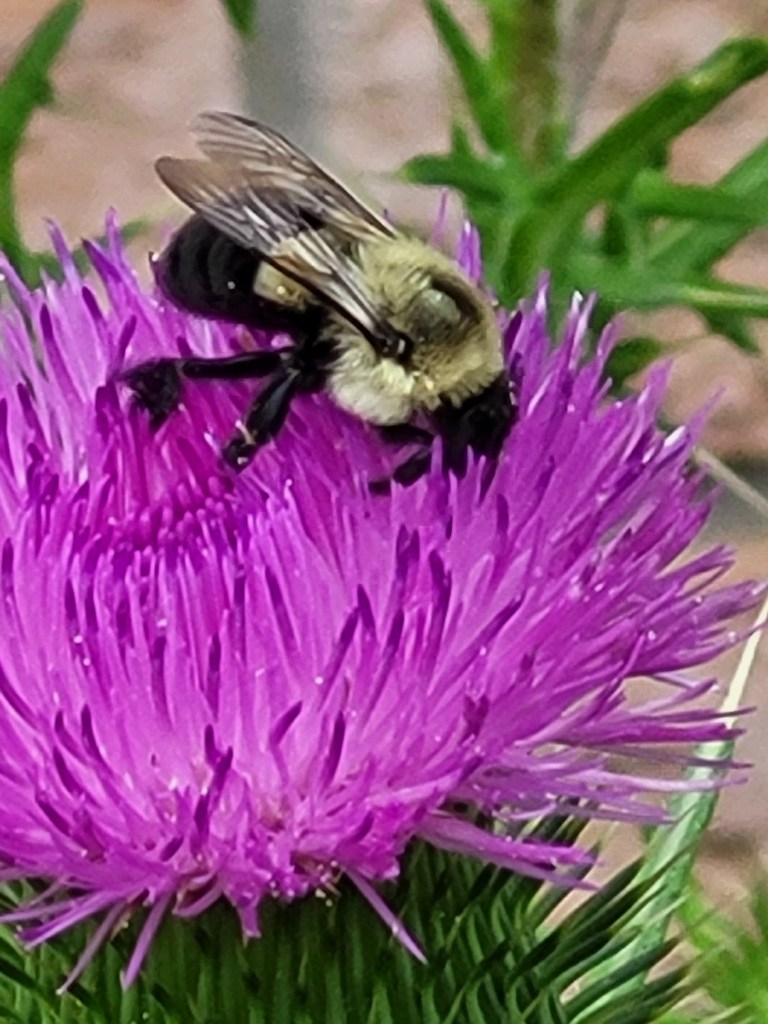
My wife and I together derive a lot of joy and satisfaction from our pollinator garden. Everyday there are amazing new discoveries. We love seeing the change of different varieties of flowers blooming throughout the season. As well, of the thrill of witnessing many happy insects that have made our garden either their home or waystation. There however has been a prickly issue between us this past summer. It is to do with a native Pasture Thistle plant that is growing alongside the walkway heading to the house. When people walk by it, there is a chance they could get scratched. My wife would like the thistle gone. The plant has been growing by the corner of our house now for a few years. It just happens that each year it is getting bigger and now it is encroaching on the walkway. I understood where she was coming from. But I felt the thistle should stay because it is such a magnet for bumblebees. They just go crazy for the flowers. They can be feasting on one flower bract for over 5 minutes, using their hind legs to push as deeply into the beautiful blossom as possible for every last bit of delicious, nutritious nectar. Getting rid of the thistle will eliminate one of the bees favorite food source. So we came up with a compromise. The thistle will stay. After the thistle has completely finished flowering later in the year, I will then carefully transplant it to another location further back from the walkway.
Thistles have a bad rap. All it takes is a Google search and page after page comes up on how to eradicate them. In Ontario we do have exotic non-native thistles. Apparently they arrived with the 1st explorers as early as the late 1600’s. The Bull Thistle and Canada Thistle are two of twenty five noxious weeds listed in Ontario. They are very invasive. They have a deep and wide spreading root system. Which means if left unchecked they can easily take over a field, a flower garden or vegetable patch. Even though invasive, just so you know if there ever is a time when there is a lack of food security, the Canada thistle plant is extremely nutritious. From the website Wildflowers and Weeds, it mentions “Young Canada thistle leaves are edible and remarkably tasty. The smaller the plant, the more tasty and sweet they are. Individual leaves can be rolled up to smash the spines and eaten like that, or placed whole on sandwiches”. Some ranchers welcome the Canada thistle in their pastures. Cattle tend to avoid the thistles, but these ranchers will train the cattle to eat younger thistles by having the plants sprayed with a mild diluted solution of salt or molasses. Which cattle love and crave. Thistles are equivalent to alfalfa in nutritional value without the bloat issues. It has a 16% protein, which is far superior to most other fresh greens. A great way to control this invasive plant without herbicides. And it provides dense nutrition at the same time. For the forager the thistle tops can be boiled as a potherb. Although not super closely related, the highly prized artichoke is also a member of the thistle family. For centuries the Indigenous peoples have used native thistle for medicinal purposes. In health food stores nowadays you can buy the related Blessed Thistle as a holistic supplement.

It is important to treat exotic invasive thistles for what they are. Invasive. Unless you are starving and need some form of food security by foraging for them, if you have a garden it is best that you completely eradicate them from your garden. Before they take over. But did you know there are an astounding 62 species of native thistles in North America? Our native thistles are much more refined and are exponentially more valuable to wildlife. They are spread by seeds and not root rhizomes. I’ve never had an issue with my one pasture thistle spreading and taking over the garden. Xerces Society for Invertebrate Conservation has released an incredible 92 page downloadable document titled “Native Thistles, A Conservation Practitioner’s Guide”. It shares everything you need to know about these amazing plants. Including how to differentiate one thistle variety from another. Sadly we live in a society where there is a lack of discernment between our beautiful native thistles and superficially similar invasive species. Even municipalities with their broad-reaching weed control policies treat all thistles (both invasive and native) as noxious. This has the potential to push historically common native thistles toward total extinction. I am grateful that my wife and I were able to come to a mutual agreement with our prickly issue. I really love watching those beautiful hungry bumblebees in action. A CNN article titled “Bumblebees are Going Extinct” mentions that “Bumblebees are among the best pollinators we have in the wildlife system.” But a critically warming planet, pesticide use and lack of habitat for food, shelter and hibernation has put their numbers in serious decline. Saving one Pasture Thistle from eradication may not seem like much. But for several bumblebees that frequent our pollinator garden it makes all the difference in the world. P.S. The two bumblebee photos taken by my wife! 🐝📸😀


 theoldfellowgoesrunning
Thank you for this useful and informative post, Carl!
So many things that I didn’t know about the thistle, especially that they are so nutritious!
I did know that the bumblebees love these prickly plants – I always see bees around the thistles.
Let’s hope that many more people with gardens see the need to keep these native thistles thriving!
LikeLiked by 1 person
You are very welcome, Catrina. I learned a lot from researching for this article. I do wonder if the bumblebees know the nutritional value of the thistles. Which is why they always seem to be feeding on them. I do hope more and more people keep the native thistles.
LikeLiked by 1 person
Marvellous!
Regards Thom
LikeLiked by 1 person
Thank you, Thom. 😀🐝
LikeLike
Happy compromise! Good for the bees, good for you. Over the past 5 to 7 years, I’ve seen everything from local schools to local municipalities work to eradicate non-native plants. I learned a lot by investigating why and what it can do for an ecosystem. Thanks for helping to educate people!
LikeLiked by 1 person
Thank you very much, Kristine. This reminds me that the thistle is ready to transplant away from the walkway. This is really wonderful there is becoming a greater awareness on our natural ecosystems and the invasive species that can wreck havoc on them. Hats off to all those individuals and organizations that are being proactive. 🌎😀
LikeLiked by 1 person